
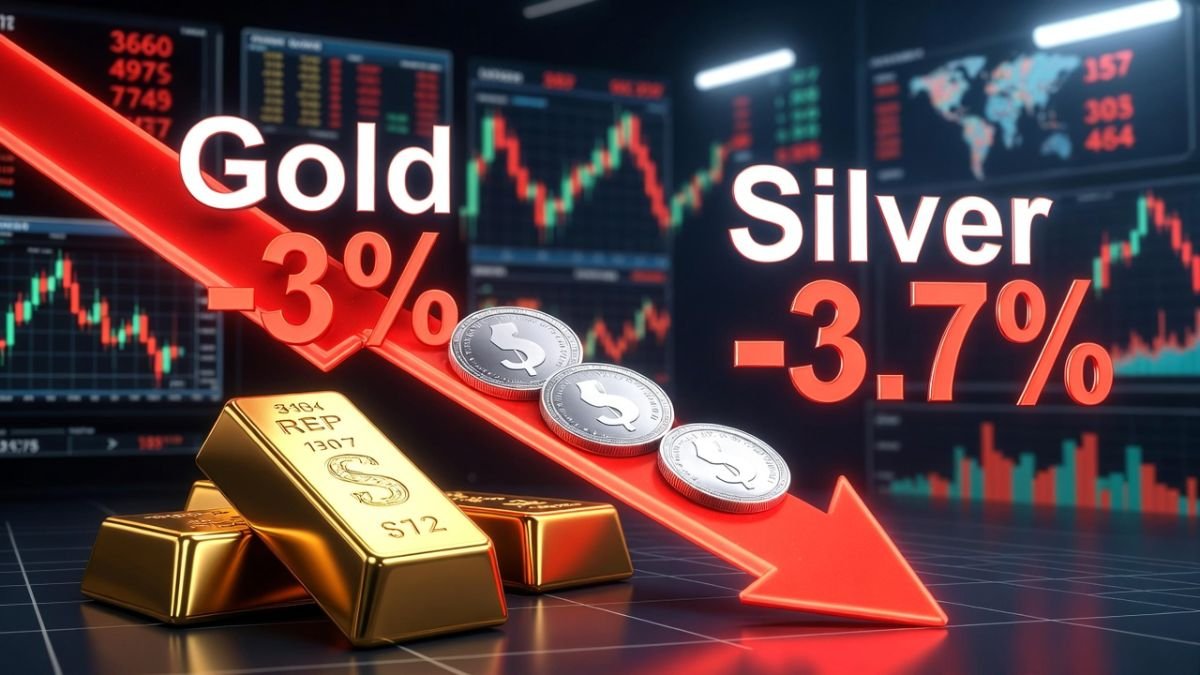
The precious metals market is witnessing a notable shift as gold and silver prices continue to slide, reflecting growing pressure from global economic signals and changing investor sentiment. Today’s live updates show gold dipping by nearly 3 percent, while silver has fallen even more sharply, down about 3.7 percent. For investors, traders, and even everyday buyers who track gold and silver for savings or jewelry purchases, this sudden decline has raised important questions about what is driving the fall and what lies ahead.
Gold and silver have long been seen as safe-haven assets, offering stability during uncertain times. However, recent movements suggest that even these traditionally resilient metals are not immune to broader market forces. Understanding today’s price action requires a closer look at global trends, monetary policy expectations, currency movements, and investor behavior.
Current Market Snapshot of Gold and Silver Prices
As of today’s trading session, gold prices have slipped significantly, marking one of the sharpest single-day declines in recent weeks. The 3 percent dip has pushed gold away from its recent highs, breaking a period of relative stability that many investors had grown accustomed to. Silver, often considered more volatile than gold, has followed the downward trend with an even steeper decline of 3.7 percent.
These movements are not isolated to one market or region. Across global exchanges, both metals are experiencing selling pressure. Spot prices, futures contracts, and even exchange-traded funds linked to precious metals are reflecting this broader downturn. For short-term traders, volatility has increased, while long-term holders are reassessing their positions.
Key Reasons Behind the Slide in Precious Metals
One of the primary reasons for the fall in gold and silver prices is the strengthening of the US dollar. Precious metals are typically priced in dollars, and when the currency gains strength, gold and silver become more expensive for holders of other currencies. This often reduces demand at the global level, leading to price declines.
Another significant factor is changing expectations around interest rates. When interest rates are expected to remain high or rise further, non-yielding assets like gold and silver tend to lose their appeal. Investors often shift funds toward interest-bearing instruments such as bonds or fixed-income assets, reducing demand for precious metals.
Additionally, improving risk sentiment in equity markets can pull investment away from safe havens. When stock markets show resilience or recovery, investors may feel more comfortable taking on risk, which can result in reduced interest in gold and silver.
Impact of Global Economic Data on Metal Prices
Recent economic data releases have played a crucial role in shaping market sentiment. Strong employment numbers, stable economic growth indicators, and controlled inflation data have reduced fears of an immediate economic slowdown. This has weakened the urgency to hold gold as a hedge against uncertainty.
At the same time, central banks across major economies continue to signal caution in their monetary policy approaches. Even small hints that interest rates may stay elevated for longer than expected can have an outsized impact on precious metals. Markets react swiftly to such signals, often leading to abrupt price corrections like the one seen today.
Silver’s Sharper Decline Compared to Gold
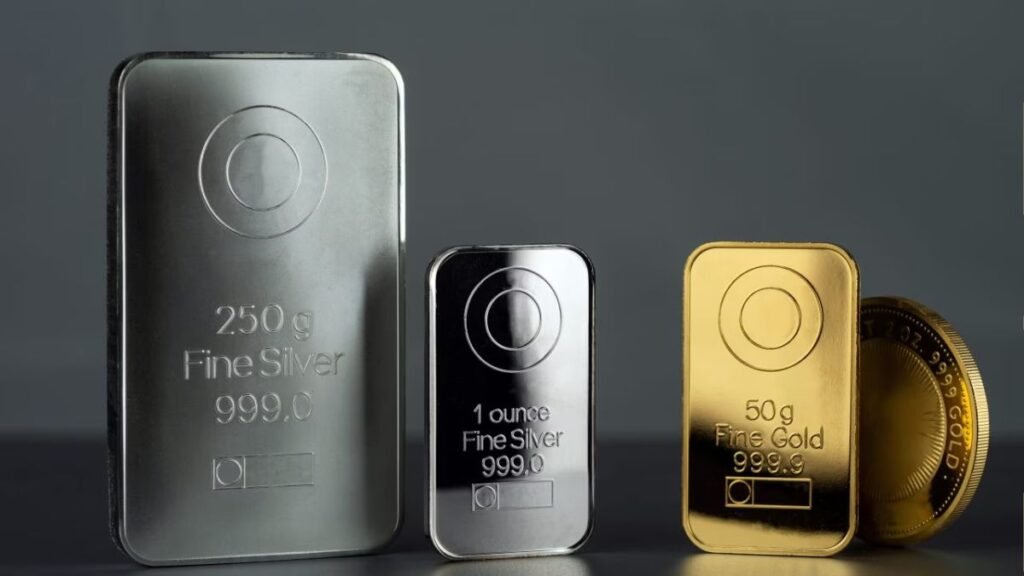
While both metals are under pressure, silver’s sharper decline deserves special attention. Unlike gold, silver has significant industrial applications, including electronics, solar panels, and manufacturing. When there are concerns about slowing industrial demand or reduced production growth, silver prices tend to react more aggressively.
Silver’s dual role as both a precious and industrial metal makes it more sensitive to economic cycles. Any indication of weaker manufacturing activity or lower industrial output can amplify price movements. Today’s 3.7 percent fall suggests that traders are factoring in not just financial trends but also potential softness in industrial demand.
Investor Sentiment and Market Psychology
Market psychology plays a powerful role in the movement of gold and silver prices. When prices begin to fall sharply, it can trigger a wave of profit-taking and stop-loss selling. Investors who entered the market at lower levels may choose to lock in gains, while others may exit positions to limit losses.
This collective behavior can accelerate price declines in a short period. Today’s slide appears to reflect such dynamics, where initial selling pressure snowballed into a broader downturn. However, it is important to note that such moves do not always indicate a long-term trend change; they can also represent temporary corrections within a larger market cycle.
How This Affects Retail Buyers and Long-Term Investors
For retail buyers, especially those interested in physical gold and silver for jewelry or savings, today’s price dip may present mixed feelings. On one hand, falling prices can create buying opportunities, making gold and silver more affordable. On the other hand, uncertainty about whether prices will fall further can make decision-making difficult.
Long-term investors often view such corrections as part of a normal market cycle. Historically, gold and silver have experienced periods of sharp declines followed by recoveries. Those with a long investment horizon may choose to hold their positions, focusing on the metals’ role as a hedge against inflation and currency risks over time.
Role of Central Banks in the Precious Metals Market
Central banks continue to be key players in the gold market. In recent years, many central banks have increased their gold reserves as part of diversification strategies. However, short-term price movements are more influenced by monetary policy signals than by long-term reserve accumulation.
When central banks emphasize inflation control and signal a firm stance on interest rates, gold prices often face downward pressure. Today’s decline suggests that markets are reacting more to policy expectations than to long-term demand fundamentals.
Technical Levels and Market Outlook
From a technical perspective, the recent drop in gold and silver prices has pushed both metals closer to important support levels. Traders closely watch these levels to assess whether prices may stabilize or continue to decline. A sustained break below key supports could invite further selling, while a bounce could indicate that the market is finding its footing.
Silver’s higher volatility means that its price action is likely to remain more pronounced in the near term. Gold, while relatively more stable, may continue to face resistance if macroeconomic conditions remain unfavorable for safe-haven assets.
What to Watch in the Coming Days
Looking ahead, investors will be closely monitoring upcoming economic data releases, central bank statements, and movements in the currency and bond markets. Any shift in inflation expectations or interest rate outlook could quickly alter the direction of gold and silver prices.
Geopolitical developments also remain an important factor. Unexpected global tensions or financial instability can rapidly revive demand for safe-haven assets, potentially reversing the current downward trend.
Final Thoughts on Today’s Gold and Silver Price Movement
Today’s live updates confirm that precious metals are under pressure, with gold dipping 3 percent and silver falling 3.7 percent. While the decline may feel unsettling, especially for those closely tracking daily price movements, it reflects a complex mix of economic signals, investor sentiment, and market dynamics.
Gold and silver have always moved in cycles, influenced by forces far beyond short-term headlines. Whether today’s slide marks a temporary correction or the beginning of a longer trend will depend on how global economic conditions evolve. For now, staying informed, understanding the underlying factors, and aligning investment decisions with long-term goals remain the most practical approach in navigating the ever-changing precious metals market.
FAQs
Q1. Why are gold and silver prices falling today?
Prices are declining due to a stronger dollar, higher interest rate expectations, and reduced safe-haven demand.
Q2. How much have gold and silver dropped today?
Gold has dipped around 3%, while silver has fallen by approximately 3.7%.
Q3. Does this price drop signal a long-term trend?
Not necessarily; short-term declines often reflect market reactions and may reverse based on economic or geopolitical changes.
