
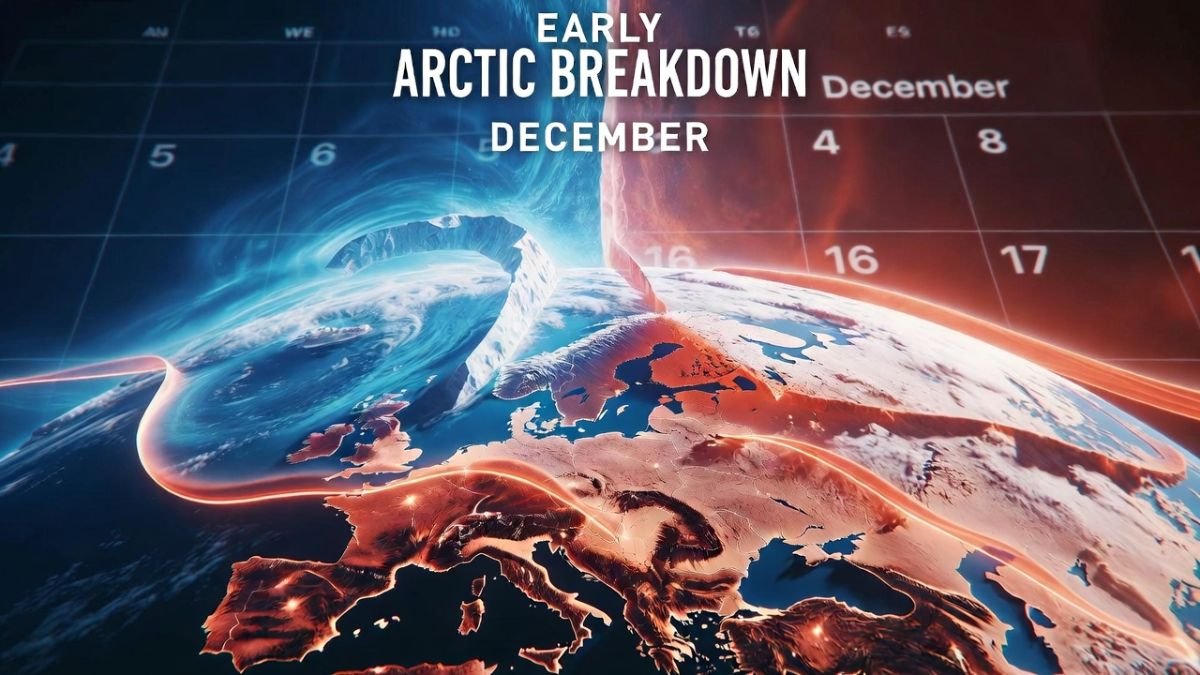
As December approaches, meteorologists around the world are sounding alarms over a developing weather pattern that is both unusual and potentially historic. An Arctic breakdown, a phenomenon typically associated with the heart of winter, is forming far earlier than expected. Even more concerning is the fact that the atmospheric signals driving this shift have not been observed in decades. For scientists, forecasters, and the general public alike, this early Arctic instability raises urgent questions about what lies ahead for winter weather and how such rare signals could reshape seasonal expectations.
Understanding What an Arctic Breakdown Really Means
An Arctic breakdown occurs when the stable circulation of cold air over the Arctic region weakens or collapses. Under normal conditions, this cold air remains locked near the pole, contained by strong atmospheric boundaries such as the polar vortex. When these boundaries weaken, Arctic air can spill southward into mid-latitude regions. This breakdown often leads to extreme cold snaps, unusual storm tracks, and sharp temperature contrasts across large parts of the Northern Hemisphere.
Why December Is an Unusual Time for This Event
Traditionally, Arctic breakdowns are more common in mid to late winter, typically between January and February. Seeing strong signals of such a breakdown forming in December is highly unusual. During early winter, atmospheric patterns are usually still stabilizing, making the Arctic circulation relatively strong. Meteorologists emphasize that the timing alone makes this event noteworthy, as it suggests a disruption occurring before winter has fully established itself.
Atmospheric Signals Not Seen in Decades
What truly sets this situation apart is the nature of the atmospheric signals being detected. Meteorologists are observing pressure patterns, jet stream behavior, and temperature anomalies that closely resemble rare events from decades past. These signals indicate a significant weakening of the Arctic’s protective atmospheric barriers. Many forecasters note that some of these indicators have not aligned in this way since the late 20th century, adding to concerns about unpredictability and intensity.
The Role of the Polar Vortex in Arctic Stability
The polar vortex plays a critical role in keeping Arctic air confined to the polar regions. When it is strong, cold air remains largely contained. However, early data suggests that the polar vortex may be destabilizing sooner than expected this season. A disrupted or weakened vortex can allow frigid air to escape southward, leading to sudden and severe winter conditions far from the Arctic itself.
Jet Stream Shifts and Their Consequences
One of the most important drivers of this early Arctic breakdown is unusual jet stream behavior. Meteorologists are tracking a jet stream that is becoming more wavy and less stable. These large undulations allow cold Arctic air to plunge south while warmer air pushes north. Such shifts can dramatically alter weather patterns, resulting in prolonged cold spells in some regions and unexpected warmth in others.
What This Could Mean for Winter Weather Patterns
An early Arctic breakdown has the potential to redefine the entire winter season. Regions that typically experience gradual cooling may instead see abrupt temperature drops. Snowfall patterns could become more erratic, with some areas facing early and intense snowstorms while others see unseasonable warmth. Meteorologists caution that once the Arctic circulation weakens early, it can set the stage for repeated cold outbreaks throughout the winter.
Impacts on North America and Europe
Forecasters are closely monitoring how this Arctic instability may affect North America and Europe. In North America, an early breakdown could bring strong cold air intrusions into the United States and Canada, increasing the risk of snowstorms, ice events, and prolonged freezing temperatures. In Europe, similar patterns could lead to sharp cold spells, disruptions to travel, and increased energy demand during a time when many countries are already managing tight winter resources.
Energy, Infrastructure, and Economic Implications
Weather anomalies of this magnitude extend beyond daily forecasts. Early and severe winter conditions can place enormous strain on energy systems as heating demand spikes. Infrastructure, including power grids and transportation networks, may face stress earlier than planned. Economically, sectors such as agriculture, logistics, and retail can be affected by sudden shifts in weather patterns, particularly if they arrive before seasonal preparations are complete.
The Influence of Climate Change on Arctic Behavior
While no single event can be directly attributed to climate change, scientists increasingly acknowledge that a warming planet is influencing Arctic dynamics. The Arctic is warming faster than the rest of the globe, a phenomenon known as Arctic amplification. This rapid warming can weaken temperature gradients that help maintain stable atmospheric circulation, making disruptions like early Arctic breakdowns more likely.
Why Scientists Are Watching This Event Closely
Meteorologists see this developing pattern as a valuable case study. The rarity of the signals involved provides an opportunity to better understand how modern atmospheric systems behave under changing climate conditions. Improved understanding could lead to more accurate long-range forecasting and better preparedness for future extreme weather events.
Public Perception and the Challenge of Communication
Communicating the risks associated with an early Arctic breakdown is not always straightforward. While terms like “Arctic collapse” or “polar vortex disruption” capture attention, meteorologists emphasize the need for balanced messaging. The goal is to inform without causing unnecessary alarm, helping the public understand potential impacts while acknowledging uncertainties inherent in weather forecasting.
Lessons From Past Rare Arctic Events
History offers important lessons about rare Arctic disruptions. Past events have shown that early-season breakdowns can lead to prolonged winter volatility. Some winters following similar patterns have featured repeated cold waves, heavy snowfall, and unpredictable temperature swings. These historical comparisons help forecasters assess potential outcomes while recognizing that no two winters are exactly alike.
How Long Could the Effects Last?
One of the biggest questions surrounding this early Arctic breakdown is duration. If the atmospheric patterns remain unstable, the effects could persist for weeks or even months. A sustained breakdown increases the likelihood of repeated cold air outbreaks rather than a single isolated event. This uncertainty makes long-term planning more challenging for governments, businesses, and individuals alike.
Preparing for an Unpredictable Winter
Meteorologists stress the importance of preparedness rather than panic. Early awareness allows communities to review winter readiness plans, ensure heating systems are functional, and stay informed about changing forecasts. Even if the most extreme scenarios do not materialize, being prepared for volatility is a sensible response to rare atmospheric signals.
The Global Nature of Arctic Influence
Although the Arctic may seem distant to many, its atmospheric behavior has global consequences. Changes in Arctic circulation can influence weather patterns across continents, affecting millions of people. This interconnectedness highlights why events occurring thousands of miles away can have immediate and tangible effects closer to home.
What Happens Next in the Forecast
As December progresses, meteorologists will continue to analyze incoming data to determine whether the early Arctic breakdown strengthens or stabilizes. Forecast models will be updated frequently, reflecting new observations from satellites, weather balloons, and ground stations. This ongoing analysis will be critical in refining predictions and understanding potential impacts.
Why This Moment Matters in Weather History
The emergence of atmospheric signals not seen in decades makes this developing situation historically significant. Whether it becomes a defining winter event or a narrowly avoided extreme, it will likely be studied for years to come. Such moments push the boundaries of scientific understanding and highlight the evolving nature of Earth’s climate system.
Final Thoughts on the Early Arctic Breakdown Warning
Meteorologists’ warning about an unusually early Arctic breakdown forming in December is more than just a seasonal forecast. It is a reminder of how dynamic and interconnected our atmosphere truly is. With rare signals emerging and potential impacts spanning continents, this event underscores the importance of science, preparedness, and public awareness. As winter unfolds, the world will be watching closely to see how this early Arctic instability shapes the months ahead.
FAQs
Q1. What is an Arctic breakdown?
It is a weakening of the Arctic’s atmospheric circulation that allows cold polar air to move southward.
Q2. Why is an early Arctic breakdown in December unusual?
Such events usually occur later in winter, so December signals are rare and historically uncommon.
Q3. What impacts could this early Arctic breakdown cause?
It may lead to extreme cold spells, unstable winter weather, and increased snowfall in some regions.
